
Last updated on September 5th, 2025 at 07:50 am
Last Updated on September 5, 2025 Posted by Colonial Acres Coins
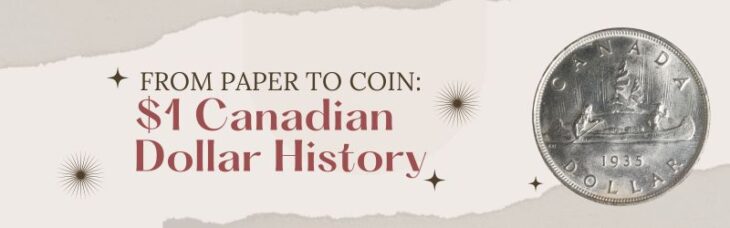
If you’ve ever slipped a “loonie” into a parking meter or dropped one in a kid’s piggy bank, you’re holding a century-spanning story in the palm of your hand. At Colonial Acres Coins, we love that the $1 Canadian coin bridges everyday life and national history—from Depression-era silver dollars to today’s iconic loon. In this deep dive, we’ll trace how Canada moved from paper dollars to a durable, decimal one-dollar coin, what life looked like in the early 1930s when our first $1 coins appeared, and how the design has evolved across the decades.
Shop our wide selection of Canadian $1 coins, from classic silver dollars to modern commemoratives:
Browse $1 coins at Colonial Acres Coins
A Quick Timeline: Banknote to Coin (and Why It Matters)
- 1858: Canada adopts a decimal currency system (dollars and cents), aligning with the U.S. system for simpler trade.
- Early 1900s: The $1 banknote is the everyday workhorse; dollar coins are rare or non-existent in circulation.
- 1935: The first Canadian silver dollar enters circulation, celebrating a royal milestone and showcasing a bold new reverse design—a watershed moment during the Great Depression.
- 1967–1968: Canada’s Centennial sparks a special $1 design; by 1968, silver is phased out of circulating dollars in favour of base metals.
- 1987: The loonie debuts, replacing the $1 banknote with an 11-sided golden coin that’s cheaper to maintain and built for heavy use.
The headline: coins last far longer than paper. Switching to a $1 coin cut replacement costs dramatically while creating a highly recognizable symbol of Canada.
The 1930s: When a Dollar Coin Felt Like a Big Deal
Picture Canada in the early 1930s: unemployment lines, cautious household budgets, and communities pulling together through the worst of the Depression. Money had weight—literally and figuratively. Into that world arrived a substantial silver dollar, a coin people could feel—and save.
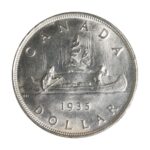
Families often kept that big silver coin tucked in a drawer or presented it as a keepsake for weddings, graduations, or newborns. It wasn’t just a change; it was a miniature heirloom. The new $1 coin also tapped into a sense of nationhood: its imagery nodded to the land, waterways, and the people who shaped Canada’s early economy.
Design that told a story
The inaugural silver $1 featured a canoe scene—often called the “Voyageur” design—showing paddlers slicing across a northern waterway under stylized aurora. It captured the fur-trade routes that knitted the country together and acknowledged Indigenous knowledge of those rivers and portages. On the obverse sat the reigning sovereign, grounding the coin in its time while establishing a template for future portraits.
From Silver to Nickel: The Mid-Century Evolution
The late 1930s through the mid-1960s turned the silver dollar into a Canadian staple. Here’s what changed—and why collectors care:
- Portrait updates: Obverse portraits changed with each monarch, and later, with new effigy styles. These transitions help date coins at a glance and add variety for set builders.
- 1967 Centennial: For Canada’s 100th birthday, the $1 traded the canoe for a Canada goose in full flight—an elegant, modernist look that remains one of the most beloved circulating designs.
- 1968 metal shift: Rising silver prices pushed the $1 out of precious metal for daily use. Circulating dollars became nickel (and later plated compositions), while silver dollars continued as collector issues from the Royal Canadian Mint.
For collectors, this is where the hunt gets fun: prooflike finishes, mintages that ebb and flow, small varieties, and memorable commemoratives. Our team at Colonial Acres can help you pinpoint key dates and varieties within these years.
The Big Switch: The 1987 Loonie
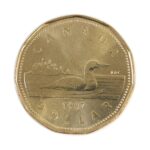
By the 1980s, the $1 banknote wore out too quickly. Enter the 1987 loonie—a smaller, golden-hued coin with an 11-sided shape you can recognize by touch. The reverse featured a common loon gliding on a northern lake, designed by Robert-Ralph Carmichael. The choice was practical and poetic: durable, distinct, and deeply Canadian.
Why the switch mattered:
- Durability & savings: A coin can circulate for decades; a note might last months.
- Accessibility: The distinctive shape helps with tactile recognition.
- Identity: The nickname “loonie” stuck overnight and, in time, inspired the “toonie” ($2 coin).
Today’s loonies are plated, multi-ply compositions engineered for longevity and machine readability, but they still carry that unmistakable loon silhouette Canadians know and love.
Decade by Decade: Highlights & Design Milestones
- 1930s: Silver Voyageur dollar debuts—big, bold, and aspirational in a frugal decade.
- 1950s: Young Queen Elizabeth II portrait appears (from 1953), giving mid-century dollars a crisp, modern profile.
- 1960s: Centennial goose (1967) becomes a design classic; 1968 ends silver in circulation.
- 1970s–1980s: Large nickel dollars continue to circulate, with prooflike collector issues booming—then 1987 reshapes the landscape with the loonie.
- 1990s–2000s: Obverse effigies evolve; commemorative loonies celebrate anniversaries, Indigenous art, wildlife, the Olympics, and national institutions.
- 2010s–2020s: Security and plating technologies improve; special editions highlight Canadian history and culture while the standard loon endures.
Want a broader view of Canadian decimal coins through time? Explore these recent reads on our blog:
- A Journey Through Canadian Numismatic History
- The Forgotten Canadian 20-Cent Coin: A Rare Treasure
- Exploring Canada’s 25-Cent Coin: More Than Pocket Change
How to Collect $1 Coins: Tips from Our Team
Whether you’re starting fresh or filling holes in a long-standing collection, a structured plan helps.
Pick a theme or run:
- Voyageur silver dollars (1930s–1960s): Build a date run or chase standout years in premium condition.
- Centennial & commemoratives: Spotlight the 1967 goose, major anniversaries, or Olympics issues.
- Loonie designs (1987–present): Create a type set of commemorative reverses alongside the standard loon.
Focus on condition: Look for sharp details (paddles, ripples, lettering), clean fields, and original lustre. For silver issues, watch for hairlines; for modern plated issues, check rims and strikes.
Mind the mintage: Lower mintages or special finishes (proof, specimen, prooflike) often command stronger premiums—especially when paired with original packaging and certificates.
Protect and present: Use inert holders or capsules and consider a labelled tray or album to make your set display-ready. We stock capsules, albums, and display cases tailored for dollars.
Fun Facts You’ll Love
- The loonie’s 11-sided (hendecagonal) shape isn’t just quirky—it helps machines and people identify it quickly.
- The “loonie” nickname became so universal that Canada’s $2 coin naturally became the “toonie.”
- Many families kept their first 1930s silver dollar as a good-luck charm or milestone gift—part coin, part time capsule.
- The 1967 goose $1 is a design icon and a favourite anchor for display sets.
- Switching from paper to coin saved millions in printing and replacement costs over time—proof that smart design pays for itself.
Why Buy from Colonial Acres Coins
We’ve spent decades curating authentic, accurately graded Canadian dollars—backed by knowledgeable staff who live and breathe numismatics. Whether you want a 1930s silver dollar with character, a pristine 1967 Centennial, or a complete loonie commemorative set, we’re here to help with fair pricing, careful packaging, and speedy shipping.
Canada’s $1 coin is more than a replacement for paper money: it’s a living storyline. From a Depression-era silver piece that felt important to hold, to a modern, cost-saving loonie recognized around the world, the dollar coin mirrors how Canadians work, save, celebrate, and remember. Start your journey—or add the next chapter—with a hand-picked piece from our collection.
👉 Explore $1 Canadian coins now and let us know what you’re building—we’ll help you find the dates, designs, and stories that bring your collection to life.